"The planet is not running at the same speed." — The defining paradox of global markets in spring 2026.
The spring of 2026 will be remembered as one of the most structurally bifurcated periods in modern financial history. On one side of the ledger: U.S. equity markets posting their best monthly performance since 2020, carried by an extraordinary earnings season and an AI-driven technology surge that defied gravity. On the other: the closure of the Strait of Hormuz — triggered by the Iran-Israel/U.S. conflict — pushing Brent crude above $120 per barrel, reigniting global inflation, and imposing asymmetric pressure on energy-importing economies across Europe, Asia, and the Middle East. This is not a standard market cycle. It is a geopolitical fracture playing out in real time across every asset class.
Table of Contents
Macro Context — The Hormuz Shock
U.S. Equity Markets — Full Speed Ahead
Sector Performance — IT's Absolute Dominance
International Markets — A Persistent Duality
Commodities & Energy Macro
Rates & Bonds — Pressure Building
Digital Assets — Institutional Maturity Under Stress
Anatomy of a Two-Speed World
Scenarios & Breakpoints
Key Statistics
FAQ
Macro Context — The Hormuz Shock
The effective closure of the Strait of Hormuz on March 4, 2026 constitutes the defining geopolitical turning point of the year — and arguably the most consequential supply shock since the 1973 oil embargo. The strait, through which approximately 21 million barrels of oil per day normally transit, became the epicenter of a cascading energy crisis the moment Iranian naval operations disrupted commercial passage in the wake of escalating military confrontation with Israel and U.S. coalition forces.
The consequences were immediate and severe. Brent crude surpassed $120 per barrel, QatarEnergy declared force majeure across all its export contracts, and the cumulative production of Kuwait, Iraq, Saudi Arabia, and the UAE fell by approximately 10 million barrels per day — a withdrawal from global supply with no short-term substitute. Energy markets had not seen a dislocation of this magnitude since the COVID-era demand collapse, and this time the shock was on the supply side.
The International Monetary Fund responded swiftly. In its April 2026 World Economic Outlook, the Fund revised emerging market growth projections downward to 3.9% from the 4.2% forecast in January, while simultaneously warning that financial stability risks were "elevated." The IMF's Global Financial Stability Report identified a web of interconnected fragilities: high sovereign debt levels, short-duration issuance, potential unwinding of carry trades in emerging markets, and excessive leverage concentrated in ETFs and non-bank financial intermediaries.
⚠ IMF GFSR APRIL 2026 — SYSTEMIC RISK ALERT
"Global financial stability risks are elevated. The combination of high sovereign debt, short-term issuance, potential EM carry trade reversals, and excessive leverage in ETFs and hedge funds constitutes a network of interconnected fragilities capable of rapidly propagating a localized shock into systemic instability."
"Global financial stability risks are elevated"
— IMF Global Financial Stability Report
The IMF's warning was particularly pointed regarding AI-linked equity concentration and non-bank leverage — two structural vulnerabilities that had been building throughout the 2024–2025 bull cycle and which, in a stress scenario, could amplify rather than absorb a geopolitical shock.
U.S. Equity Markets — Full Speed Ahead
If the Hormuz closure defined the risk environment of spring 2026, the U.S. equity market's response defined its paradox. Rather than retreating in the face of geopolitical uncertainty, American large-cap equities surged to all-time highs — a counterintuitive dynamic explained by three converging forces: domestic energy insulation, an exceptional Q1 2026 earnings season, and structural AI investment demand that operates largely independently of the oil cycle.
April 2026: A Historic Month
| Index | Level | Monthly Performance | YTD Performance | Signal |
| S&P 500 | 7,230 | +10.5% | +6.0% | All-Time High (May 1) |
| NASDAQ Composite | 25,114 | +8.2% (YTD) | +8.2% | Intraday Record (late April) |
| Dow Jones Industrial | 49,499 | +3.5% (YTD) | +3.5% | Best since Nov. 2024 |
| Russell 2000 | — | +12.3% | +13.7% | Best month since Nov. 2020 |
The S&P 500's 10.5% monthly gain in April was the index's strongest monthly performance since the post-COVID recovery of November 2020. The Russell 2000 — historically the most sensitive index to domestic economic conditions — matched that feat with a +12.3% monthly return, its best since November 2020, signaling that the rally was not confined to mega-cap technology names.
📊 +10.5% — Best Month Since 2020 - S&P 500 April 2026 Monthly Return
The Nasdaq's 13 consecutive sessions of gains — the longest winning streak since 1992 — was the statistical signature of the AI investment thesis playing out in real time. The catalyst was a Q1 2026 earnings season that exceeded even optimistic projections: 84% of S&P 500 companies beat EPS estimates, a beat rate that ranks among the highest in the index's history. Individual standouts included:
- AMD: +18.6% following earnings that surpassed consensus on both revenue and forward guidance
- Super Micro Computer (SMCI): +24.5% on data center demand acceleration
- NVIDIA: +5.7%, contributing the largest individual point gain to the S&P 500 by virtue of its massive market capitalization
The underlying message from the earnings season was clear: enterprise AI capital expenditure — the data centers, the chips, the inference infrastructure — was not slowing down. It was accelerating.
Sector Performance — IT's Absolute Dominance
The April 2026 sector breakdown of the S&P 500 reveals a performance dispersion rarely observed within a single calendar month:
| Sector | April 2026 Return | vs. S&P 500 | Key Driver |
| Information Technology | +20.02% | +9.5 pts | AI capex cycle, earnings beats |
| Communication Services | +18.5% | +8.0 pts | Meta, Alphabet AI monetization |
| Real Estate | +8.74% | -1.8 pts | Rate stabilization expectations |
| Consumer Discretionary | +8.60% | -1.9 pts | Resilient U.S. consumer |
| Industrials | +7.95% | -2.6 pts | Defense, infrastructure spending |
| Financials | +5.59% | -4.9 pts | Earnings solid, rate sensitivity |
| Materials | +3.00% | -7.5 pts | Mixed commodity signals |
| Health Care | -0.42% | -10.9 pts | Regulatory headwinds |
| Energy | -2.63% | -13.1 pts | Paradox: high oil, priced-in resolution |
The Energy sector's -2.63% decline in a month where Brent crude was trading above $100 per barrel represents one of the most striking paradoxes of the period. Markets were not pricing the current oil level — they were pricing the expected oil level post-resolution. The implicit assumption embedded in energy equity valuations was that the Strait of Hormuz would reopen, that the conflict premium would dissipate, and that normalized supply would return. It was a bet on diplomacy, expressed through sector rotation.
"IT advanced 20%, outperforming the S&P 500 by nearly 10 percentage points — a dominance virtually without precedent in a single calendar month."
— CommunityAmerica / Nasdaq Sector Analysis, May 2026
International Markets — A Persistent Duality
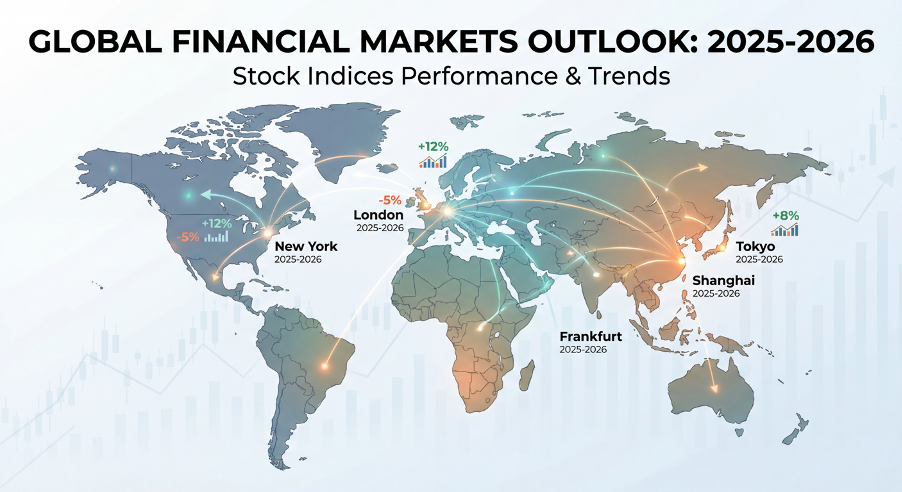
The global equity landscape in April–May 2026 is best understood as two distinct worlds operating under the same nominal label of "financial markets" but experiencing radically different underlying dynamics.
Markets Accelerating
| Index / Region | YTD Performance | Q2 2026 | Fwd P/E (NTM) | Signal |
| MSCI Emerging Markets | +14.4% | +14.6% | 12.1x | Attractive |
| MSCI EAFE (Europe/Asia Dev.) | +6.5% | +7.8% | 15.3x | Neutral |
| S&P 500 | +6.0% | +10.8% | 21.0x | Bullish |
| NASDAQ Composite | +8.2% | +16.3% | 25.7x | Bullish |
| Russell 2000 | +13.7% | +12.7% | 25.3x | Strong |
| Dow Jones Industrials | +3.5% | +6.9% | 13.1x | Moderate |
Sources: Wespath Market Performance Summary — May 8, 2026 · Nasdaq April 2026 Review
MSCI Emerging Markets at +14.4% YTD represents a significant outperformance relative to developed European equities — a reversal of the multi-year trend that had favored U.S. and European large caps. The outperformance is driven by Asian markets (which recorded absolute highs in early May on Hormuz reopening hopes) and commodity-exporting economies (Brazil, South Africa, Mexico) that benefit directly from elevated raw material prices.
📊 +14.4% as of May 8, 2026 - MSCI Emerging Markets YTD Return
Markets Under Pressure
- Euro Stoxx 600: Slight decline in mid-May — energy import exposure and persistent inflation
- DAX / CAC 40 / FTSE MIB: Between -0.2% and -0.4% in early May — investor caution prevails
- FTSE 100: -0.7% on May 7 — penalized by commodities exposure and sterling weakness
- Nikkei 225: -1.0% on May 18 — yen pressure, Bank of Japan exposed to yield curve control tensions
- Gulf & Middle East: Humanitarian crisis, food supply disruption, expatriate capital outflows
The Asia dynamic is the most internally contradictory: markets reached absolute records in early May on Hormuz reopening expectations, then reversed sharply in mid-May when Chinese April industrial production and retail sales data came in below consensus. China — as the world's largest energy importer through the strait — represents a central adjustment variable for the entire regional picture.
"MSCI AC World ex-USA returned +9.2% YTD through May 2026, historically strong for non-U.S. developed markets"
— Wespath Market Performance Summary
Commodities & Energy Macro
Oil: The De Facto Policy Rate of 2026
| Commodity | Current Level | Key Event | Trajectory |
| Brent Crude | ~$100–120/bbl | Peaked above $120 post-Hormuz closure | -8% on May 7 (deal hopes) |
| WTI Crude | ~$96–104/bbl | +4% on April 23 alone; $103.27 on May 1 | Declining on diplomacy signals |
| Gold (XAU/USD) | $4,550/oz | Goldman Sachs target: $5,400 by end-2026 | Supported by central bank buying |
The oil price is not merely a commodity variable in 2026 — it is the de facto policy rate for emerging markets. As Amundi's Global Investment Views noted in April 2026, every additional dollar on Brent translates into 15–20 basis points of additional spread pressure on sovereign bonds of energy-importing nations. At $120/barrel, the cumulative effect on countries like Egypt, Bangladesh, Pakistan, and the Philippines is equivalent to a severe monetary tightening — without any of the domestic policy tools to counteract it.
"The oil price has become the de facto benchmark rate for emerging markets. Every additional dollar on Brent translates into 15–20 basis points of additional pressure on sovereign spreads of importing nations."
— Amundi Global Investment Views, April 2026
"Oil price acts as de facto EM benchmark rate at 15-20bps spread impact per dollar"
— Amundi Global Investment Views
The May 7 episode was the most dramatic single-session commodity event of the period: on reports that Washington and Tehran were approaching an agreement for a phased reopening of the strait, Brent crude futures collapsed 8% in a single session, falling below $100. This mirror movement — explosion then hope of resolution — orchestrated the sector rotations observed across equity markets throughout the spring.
Gold: The Structural Safe Haven
Gold at $4,550 per ounce in mid-May 2026 is not a crisis spike — it is the culmination of a multi-year structural trend. Goldman Sachs projects a target of $5,400 by year-end 2026, supported by two durable demand pillars: central bank purchases averaging 60 tonnes per month in 2026, and the ongoing de-dollarization of global reserves. Amundi notes that while the dollar may remain resilient in the short term due to its safe-haven status, structural pressures — U.S. fiscal dynamics, geopolitically-driven capital flow shifts — argue for medium-term weakening.
📊 $4,550/oz — Goldman Sachs Target $5,400 by Year-End - Gold Price Mid-May 2026
Rates & Bonds — Pressure Building
| Instrument | Level | Move | Signal |
| U.S. Treasury 2Y | 3.95% | +6bps in one session (May 4) | Fed expectations sensitive |
| U.S. Treasury 10Y | 4.44% | +6bps in one session (May 4) | Energy → Inflation → Yields |
| U.S. Treasury 30Y | 5.02% | Crossed 5% on May 4 | Long-term vigilance signal |
| S&P 500 Fwd P/E | 20.9x | Above historical average | Supported by EPS growth |
The 30-year Treasury crossing 5% on May 4 was interpreted by bond markets as a structural signal — not merely a cyclical one. It reflects the fundamental tension of the moment: an economy generating above-trend growth and above-target inflation through an energy shock, facing a Federal Reserve in leadership transition (Jerome Powell formally ceding his position to Kevin Warsh on May 15), with no clear policy anchor for the medium term.
Warsh, perceived as more hawkish than his predecessor, inherits a complex mandate: inflation running above 2% due to exogenous supply factors, a labor market still relatively tight, and a bond market beginning to price in fiscal sustainability concerns at the long end. The sovereign-bank nexus identified by the IMF GFSR — whereby banks holding long-duration bonds face mark-to-market losses that constrain lending capacity — remains an underappreciated tail risk.
The positive offset: corporate earnings have been sufficiently robust to sustain equity valuations despite rate pressure. The S&P 500's forward P/E of 20.9x sits above historical averages but is considered defensible by analysts given upward revisions to Q2 and full-year 2026 EPS estimates following the Q1 beat cycle.
Digital Assets — Institutional Maturity Under Stress
| Asset | Level | Performance | Key Catalyst |
| Bitcoin (BTC) | ~$73,000–76,000 | +11.87% in April | ATH $126K (Oct. 2025) — now consolidating |
| Ethereum (ETH) | ~$2,200 | -27% YTD (mid-April) | Glamsterdam fork targeted June 2026 |
| Bitcoin ETF Flows | $2.44B net inflows | April record for 2026 | BlackRock IBIT: 85% of flows |
| BTC/S&P 500 Correlation | 84% | — | Full institutionalization confirmed |
| BTC/Gold Correlation | 87% | — | Macro asset classification |
The crypto market in April–May 2026 is that of conflicted institutional maturity. Bitcoin, having reached an all-time high of $126,000 in October 2025, is now in a consolidation phase around $73,000–76,000 — a -40% drawdown from peak that would have triggered existential narratives in prior cycles but is now absorbed with relative equanimity by institutional participants. The 84% correlation with the S&P 500 confirms Bitcoin's definitive reclassification as a macro asset — not a decorrelated alternative.
The month's genuine surprise: Bitcoin ETFs recorded $2.44 billion in net inflows in April — double the March figure — with BlackRock's IBIT capturing 85% of those flows. This is not speculative retail demand. It is structural institutional allocation, driven by wealth management platforms, pension fund exploratory positions, and corporate treasury diversification. The CLARITY Act, validated by the Senate committee, would provide the regulatory framework to accelerate this trend further.
For Ethereum, the anticipated catalyst is the Glamsterdam fork (targeted June 2026), with historical precedent showing 35–60% appreciation ahead of major protocol upgrades since The Merge. The -27% YTD figure in mid-April reflects macro headwinds and relative underperformance versus Bitcoin, but the technical setup for a pre-fork rally is building.
Anatomy of a Two-Speed World
The "two-speed world" metaphor transcends the simple developed/emerging binary. It describes a structural fracture in the transmission of the Hormuz shock — economies that absorb the energy price increase as an inflationary tax versus those that either produce their own energy or benefit from technology demand that operates independently of the oil cycle.
Accelerating Economies
| Economy / Sector | Mechanism | Key Indicator |
| United States | Domestic shale production, LNG exports, AI capex | S&P 500 +10.5% in April |
| EM Commodity Exporters (Brazil, South Africa, Mexico) | Direct commodity price beneficiaries | MSCI EM +14.4% YTD |
| India | Emergency waiver on Russian oil (March 6), domestic demand resilience | Relative outperformance vs. EM peers |
| AI / Semiconductor Sector | Capex cycle independent of oil dynamics | NVIDIA, AMD, SMCI multi-month highs |
Decelerating Economies
| Economy / Region | Mechanism | Key Indicator |
| Gulf States | 80% of caloric imports via the strait, humanitarian crisis, capital outflows | Market closures, currency pressure |
| Europe | Net energy importer, inflation persistence, limited ECB room | Stoxx 600 in negative territory mid-May |
| Energy-Importing Asia | Philippines (state of emergency), Bangladesh, Vietnam, Pakistan — fuel shortages | Currency depreciation, current account deterioration |
| Egypt | $10B Suez Canal revenue loss, GERD negotiations paralyzed, pound under pressure | Sovereign spread widening |
The United States occupies a uniquely privileged position in this landscape. Its domestic hydrocarbon production (shale) provides partial insulation from Middle Eastern supply disruptions. Its technology sector — the dominant driver of equity returns — operates on a capex cycle funded by corporate AI investment that is structurally independent of the oil price. And its safe-haven currency status means that capital fleeing geopolitical risk flows into dollar assets, not away from them. This is the arithmetic of American exceptionalism in 2026.
Europe faces the inverse dynamic: a net energy importer with limited domestic substitutes, persistent underlying inflation that constrains ECB flexibility, and equity markets dominated by sectors (financials, industrials, consumer staples) that lack the re-rating catalyst of AI investment. The result is a continent that is neither in recession nor in expansion — it is in suspension.
Scenarios & Breakpoints
Bullish Scenarios
1. Hormuz Reopening Agreement
A U.S.-Iran deal enabling phased resumption of energy exports would mechanically push Brent below $80, defuse inflationary pressures globally, and enable a synchronized global recovery. Markets have already partially priced this scenario — the May 7 episode demonstrated the magnitude of the potential move.
2. Fed Warsh Dovish Surprise
Kevin Warsh is priced as hawkish. Any dovish communication in his first Fed appearances — signaling rate cuts before year-end — would provide a significant impulse to risk assets, particularly rate-sensitive sectors (real estate, utilities, small caps).
3. CLARITY Act Crypto Legislation
Senate committee approval of the CLARITY Act would provide a durable legal framework for digital assets, potentially catalyzing tens of billions in institutional inflows and re-rating the entire crypto asset class.
Bearish Scenarios
1. Conflict Escalation
Extension of strikes to oil infrastructure, or involvement of additional actors (Hezbollah, Houthis at scale), would maintain Brent above $120 and likely trigger a global recession in H2 2026. The IMF's systemic risk framework identifies this as the scenario most capable of converting financial turbulence into systemic instability.
2. Bond Market Shock
The 30-year U.S. Treasury above 5% is a fragility indicator. A further rise to 5.5%+ would stress bank balance sheets exposed to long-duration bonds, potentially triggering the sovereign-bank nexus dynamic identified by the IMF GFSR. This risk is currently underpriced by equity markets.
3. AI Concentration Unwind
Nasdaq forward P/E at 25.7x is stretched. A NVIDIA earnings miss, a Meta capex guidance reduction, or any credible signal that AI monetization is slower than expected could trigger a rapid de-rating of the technology sector — the one pillar sustaining U.S. equity outperformance.
Key Statistics
📊 10.5% — S&P 500 monthly gain in April 2026, its best monthly performance since November 2020 (Source: Nasdaq April 2026 Review)
🛢️ $120+ — Peak Brent crude price following Hormuz closure, before falling 8% in a single session on May 7 on deal hopes (Source: Wikipedia — Economic Impact of 2026 Iran War)
🏅 $4,550/oz — Gold price in mid-May 2026, with Goldman Sachs projecting $5,400 by year-end on central bank buying of 60 tonnes/month (Source: Goldman Sachs Commodities Research 2026)
📈 84% — Correlation between Bitcoin and the S&P 500 in spring 2026, confirming crypto's full integration into the macro asset universe (Source: Patronus Partners / CommunityAmerica Analysis)
💡 $2.44B — Net inflows into Bitcoin ETFs in April 2026, double the March figure, with BlackRock's IBIT capturing 85% of flows (Source: Nasdaq April 2026 Review)
🌍 3.9% — IMF revised emerging market growth forecast for 2026, down from 4.2% in January, following the Hormuz supply shock (Source: IMF World Economic Outlook, April 2026)
📊 3.9% (down from 4.2%) - IMF Emerging Market Growth Revision 2026
Frequently Asked Questions (FAQ)
What caused the divergence in global financial market performance in April–May 2026?
The primary driver of the two-speed dynamic was the closure of the Strait of Hormuz in March 2026, which pushed Brent crude above $120/barrel and created asymmetric pressure across economies. Energy-importing nations — particularly in Europe, South and Southeast Asia, and the Middle East — faced imported inflation and growth headwinds, while the United States benefited from domestic energy production, an AI-driven technology earnings surge, and safe-haven capital inflows. The result was a historic divergence: S&P 500 up 10.5% in April while European indices declined.
Why did U.S. technology stocks rally during a period of geopolitical crisis?
The AI investment cycle — driven by enterprise capital expenditure on data centers, semiconductors, and inference infrastructure — operates largely independently of the oil price cycle. Companies like NVIDIA, AMD, and Super Micro Computer reported Q1 2026 results that dramatically exceeded expectations, with 84% of S&P 500 companies beating EPS estimates. The market interpreted these results as evidence that AI monetization was accelerating, justifying elevated valuations even in a high-rate, high-energy-cost environment.
What is the significance of the U.S. 30-year Treasury crossing 5%?
The 30-year U.S. Treasury yield crossing 5% on May 4, 2026 is a structural signal that bond markets are pricing persistent above-target inflation and growing fiscal sustainability concerns. For financial institutions holding long-duration bonds, this creates mark-to-market losses that can constrain lending capacity — the "sovereign-bank nexus" risk identified by the IMF. It also raises the cost of capital for long-duration assets (real estate, infrastructure, growth equities) and complicates the Fed's transition under incoming Chair Kevin Warsh.
How has the Hormuz crisis affected emerging market financial stability?
The impact has been highly differentiated. Commodity-exporting emerging markets (Brazil, South Africa, Mexico) have benefited from elevated raw material prices, with the MSCI Emerging Markets index up 14.4% YTD. However, energy-importing emerging economies — Egypt, Bangladesh, Pakistan, the Philippines — face a severe combination of currency depreciation, widening sovereign spreads (15–20 basis points per additional dollar on Brent, according to Amundi), fuel shortages, and current account deterioration. Egypt alone has lost an estimated $10 billion in Suez Canal revenues.
What are the main scenarios for global markets in H2 2026?
The two dominant scenarios are: (1) Hormuz resolution — a U.S.-Iran agreement enabling phased energy export resumption would push Brent below $80, defuse global inflation, and enable synchronized recovery across asset classes; (2) Conflict escalation — extension of strikes to oil infrastructure or involvement of additional regional actors would maintain Brent above $120 and likely trigger a global recession in H2 2026. A third risk — AI concentration unwind — is specific to U.S. equity markets, where Nasdaq forward P/E at 25.7x leaves limited margin for earnings disappointment.
April–May 2026 will be recorded in financial history as the period when markets navigated between fear and hope with extraordinary precision — and ultimately, in the United States at least, chose hope. The fear was real: inflation of war, uncontrolled bond yields, imported recession. The hope was equally real: diplomatic resolution, a historic earnings season, and a technological revolution that appeared to justify premium valuations.
For now, hope is winning — on Wall Street. For the rest of the world, the energy bill continues to write a different story.
The most important variable for H2 2026 is not monetary policy, not corporate earnings, and not even AI adoption curves. It is a narrow waterway 33 kilometers wide at its most constrained point. The Strait of Hormuz is, in 2026, the single most important price-setting mechanism in global finance. Its reopening or continued closure will determine whether the two-speed world converges or fractures further.
Investors navigating this environment should maintain diversified exposure across geographies and asset classes, with particular attention to the asymmetric scenarios outlined above. The IMF's warning on systemic risk concentration is not background noise — it is the central risk management framework for the months ahead.
This report is produced for informational and analytical purposes only. It does not constitute investment advice.
Sources: IMF World Economic Outlook & Global Financial Stability Report, April 2026 · Nasdaq April 2026 Review · CNBC · Euronews · Patronus Partners · CommunityAmerica · Wikipedia (Economic Impact of the 2026 Iran War) · Wespath Market Performance Summary, May 8, 2026 · Amundi Global Investment Views, April 2026 · Goldman Sachs Commodities Research 2026 · BlackRock Weekly Market Commentary, May 2026 · Morningstar Q1 2026 Review & Q2 Outlook































































































Share
00 Comments
No Comments found!